
Worth considering
Pet glucose meter
Home glucose checks
- + Small blood sample
- + Portable
- Limit: Requires vet guidance and ongoing strips
Check meter and strip compatibility before buying.
Compare pet glucose meters on Amazon UK0 results
A diagnosis feels frightening at first. Mello explains it in plain English: what the numbers mean, what to feed, which kit is worth buying and what to ask your vet. It then keeps the record, so you arrive at appointments with answers.
The app was checked screen by screen by Dr Linda Simon MVB MRCVS, a veterinary surgeon with 13 years in practice and a special interest in endocrinology, who also reviewed 13 of our guides. Reviewed guides say so at the foot of the page.
Bramble
Example pet · Today
Latest glucose reading
6.8 mmol/L
Within your saved target rangeLogged at 07:02 · 58 minutes ago
Last insulin · given 19:40 yesterday, by Alex
One tap. The amount is never filled in for you.
Today
Breakfast: ate as usual 07:10 · Sam
Glucose 6.8 mmol/L 07:02 · Sam

Tell us where you are, and we'll point you to what helps.
Won't eat, possible hypo, a missed or doubled dose, ketones, or suddenly unwell.
See emergency stepsThe first few days are the hardest. Start here for the practical next steps.
Start hereDaily routines, feeding guidance, and the monitoring habits that keep things steady.
See daily routinesGet your data organised and learn what questions matter most.
Prepare for the visitA few common early signs to watch for.
Not a diagnosis: always confirm with your vet.
Mello in your day
So you're not relying on memory when your vet asks what changed.
Simple tools for converting readings, planning costs and preparing for vet visits.
Convert glucose readings between mmol/L (used in the UK) and mg/dL (used in the US) instantly.
Add up your own monthly costs for insulin, supplies, food and insurance, so you can plan ahead.
See an example of the report the Mello app is being built to produce, using made-up readings.
A calmer record
A consistent record gives your vet a clearer picture than scattered notes.
Most diabetes care happens at home, where you give the injections and notice changes. Mello keeps glucose, insulin, meals and notes in one place, so you are not relying on memory or a scrap of paper. Your vet gets a clear record.
Five quick fields (time, glucose, insulin, meals, notes), and you're finished for the day.
Charts show every reading against the range your vet set, over whatever period you choose. Note appetite, energy and water intake too, so changes show up early.
Example data (not real readings)
Typical week of glucose readings showing target range and variation
Example only. The shaded band is the range this owner’s vet set for their pet.
Mello does not have a target range of its own. Without one from your vet, it shows the number and says nothing about whether it is high or low.
Pick a period, check what is in it, send it. Every entry with its time, amount and who recorded it, so you talk about what happened instead of squinting at three weeks of notes.
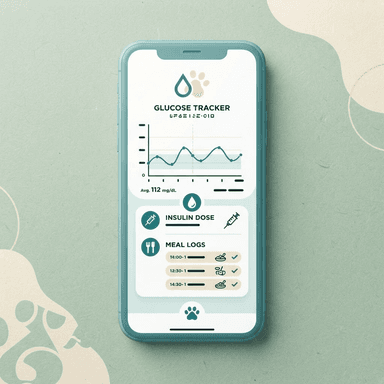
An app for daily diabetes care, coming to Google Play.
Coming to Google Play
The app is not on Google Play yet. Join the early-access list and we will email you when it is.
Why Mello exists
I'm Conor Brennan. I run Lanayr Ltd, in Scotland. I'm not a vet. Mello is a tracking tool, so your vet is always the one to ask.
I started building it after watching friends try to manage a pet with diabetes: injections twice a day timed around meals, readings written on whatever was to hand, and then the appointment where the vet asks how the last fortnight went and nobody can quite say.
I wanted to build something super easy to use, that fits into normal daily life and helps you manage it without it taking over the day.
Start with the right route
Choose the short species-specific overview, then follow the links to the detailed guide you need.
Our guides draw on published veterinary sources, such as the AAHA Diabetes Management Guidelines for dogs and cats and the 2025 iCatCare consensus guidelines for cats. Every guide is dated and lists what it drew on. It is general information rather than advice about your own pet, so always check with your vet before changing anything about their care. Mello is a communication tool, built to make that conversation clearer and faster.
Nobody hands you a kit list at diagnosis. These are the items owners most often need in the first few months, with what each does and does not do. Ask your vet before changing anything about your pet's treatment.
Products are selected for practical usefulness, compatibility and transparent pricing. See How we choose products.
Worth considering
Home glucose checks
Check meter and strip compatibility before buying.
Compare pet glucose meters on Amazon UKWorth considering
Safe disposal of used needles and lancets
Any BS-marked sharps container is suitable for insulin needles and lancets. Size is the only real choice: a 1 litre bin suits most single-pet households.
See sharps bins on Amazon UKWorth considering
Travel and transport
Confirm the case can hold your insulin and does not freeze it.
See insulin cooling cases on Amazon UKWorth considering
Measuring meals
Use alongside the feeding plan your vet has given you.
See digital kitchen scales on Amazon UKMore in the full equipment guide, including continuous glucose monitors, feeders and storage.
Popular questions
Drinking and urinating much more than usual, losing weight despite a good appetite, and tiredness. Many diabetic dogs also develop cataracts, a clouding of the lens, sometimes quickly, and for some owners cloudy eyes are the first thing they notice.
Signs in dogs →The same thirst, urination and weight loss as in dogs, but cataracts are rare. One sign is specific to cats: diabetic neuropathy can make them walk flat on their hocks rather than up on their toes, giving a crouched, flat-footed back end.
Signs in cats →Consistency matters more than any particular brand: the same food, the same amount, at the same times each day, timed around the injections. Some dogs do well on a good-quality maintenance diet and others need a therapeutic one: your vet decides which.
Feeding a diabetic dog →Diet does more for a diabetic cat than for a diabetic dog. Most vets aim for a low-carbohydrate wet food, around 5–10% carbohydrate on a dry-matter basis. Measure the daily ration; a cat that grazes can still be managed.
Feeding a diabetic cat →A series of blood glucose readings taken across 12 or 24 hours, so your vet can see how your pet responds to their insulin over a whole dosing cycle rather than at a single moment. It can be done at the practice or at home if your vet asks for one.
How glucose curves work →Do not inject and then hope. Insulin given to a pet that has not eaten, or that has vomited the meal back up, can take blood sugar dangerously low. Contact your vet before the dose. This is one of the most common reasons owners ring out of hours, and they expect it.
If your pet refuses food →Never double up to catch up. Too much insulin is far more dangerous than too little, so an uncertain dose is a call to your vet rather than a decision to make alone. If a dose may have been given twice, treat it as urgent.
Missed and uncertain doses →Weakness, wobbliness, trembling, a vacant look, sudden intense hunger and, in severe cases, collapse or seizures. Contact your vet immediately. If they are unconscious or seizing, put nothing in their mouth and go straight to a vet. The full steps are in our hypoglycaemia guide.
The hypoglycaemia guide →Some cats can, with early effective treatment and ongoing veterinary monitoring, though it is never guaranteed and diabetes can come back. Dogs usually need insulin for life, because their diabetes more often involves a loss of insulin production rather than resistance to it.
Cat diabetes and remission →No, and it never will. Mello records what was given and when, and who gave it. It does not calculate, suggest or imply a dose, and a reading is only called high or low against the range your own vet set. Without one, Mello shows the number and says nothing about it.
What the app does and does not do →Be the first to know when the Mello app is on Google Play.